Many Arms Make Light Work: An AI Skill for the Ceph Contribution Loop
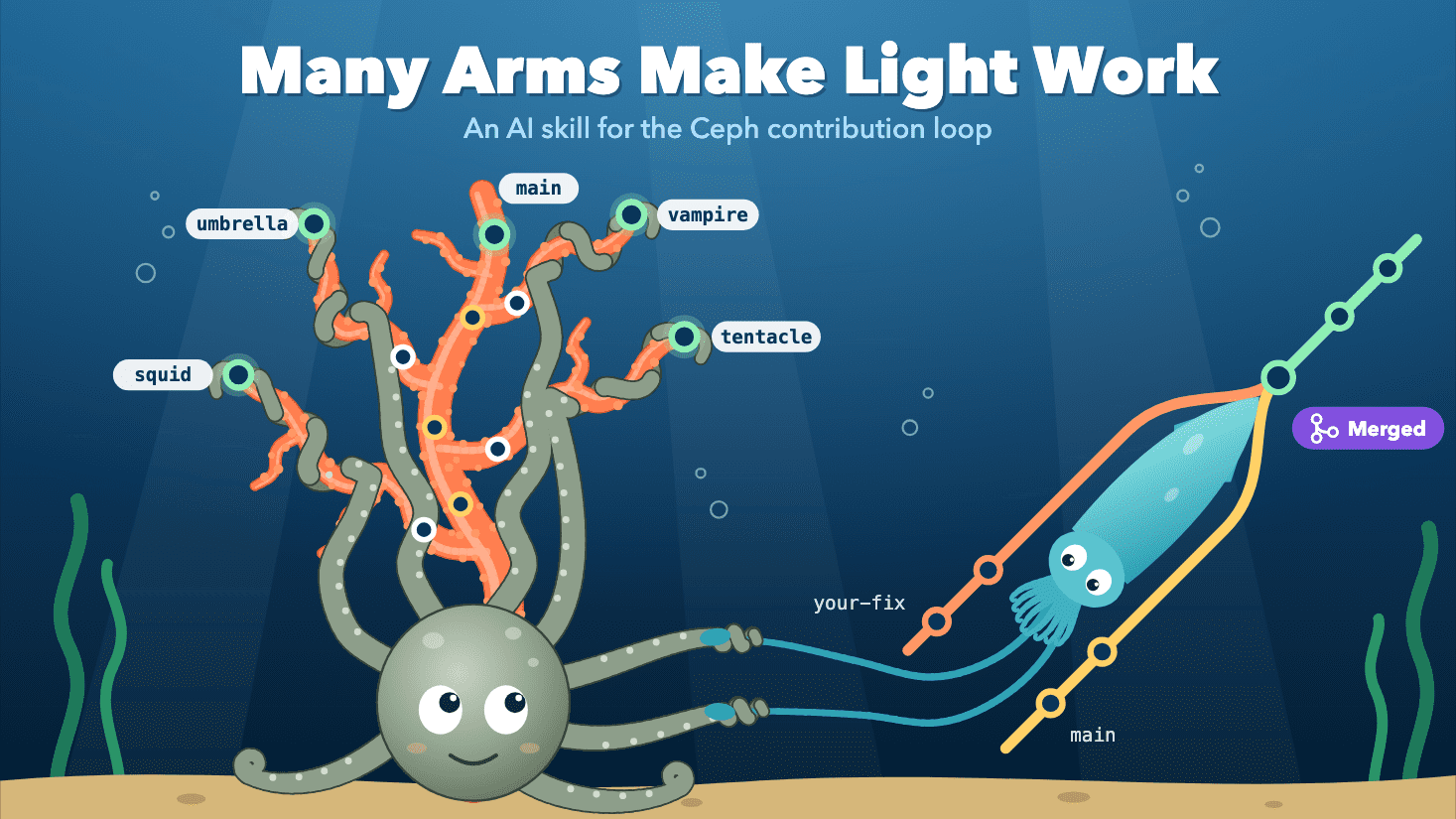
Many arms 
The Ceph community is wonderfully varied. Yes, there are kernel developers and RADOS engineers, but there are also admins running petabytes in production, documentation writers, QA folks who live in teuthology, dashboard designers, packagers, students, and people who first showed up to ask why their PGs were stuck and stayed to help the next person. They work at hyperscalers, universities, research labs, startups, and small shops with one cluster and a lot of heart. They span every time zone and many languages.
That diversity is our strength. A bug report from an admin who has seen a failure at scale, a doc fix from someone who just tripped over a confusing paragraph, a test from someone who reads code for fun: each comes from a perspective that a room of like-minded developers would miss. A storage system that serves everyone is best shaped by everyone.
Then you try to contribute, and the process can be daunting.
The loop is long 
A change to Ceph is not just a patch. It is a loop:
- The tracker. Find or file the issue on tracker.ceph.com, make sure nobody else is already on it, and move it through statuses whose rules differ from project to project.
- The pull request. Branch from
main, commit with aSigned-off-byline and aFixes:link to the tracker, prefix the title with the component, and fill out the PR template's checklist. - The checks and the bots. Get CI green. Learn which Jenkins trigger phrase reruns which job, when the config-change bot wants a
/config check ok, why Read the Docs failed, and what the Backport Audit is complaining about. - The merge. Respond to review, rebase, rebase again to fix the 451 unrelated commits you dragged in, wait. When the PR merges, the Redmine Upkeep Bot moves the tracker issue to Pending Backport and opens one backport issue per release.
- The backports. Do it all again, once for each stable branch.
None of these steps is unreasonable on its own. Each exists for a good reason, usually a painful one. Together they are a lot to hold in your head, and the knowledge is scattered across several documents, PR templates, bot comments, and the memories of a few release managers.
Backports are byzantine 
Backports deserve their own section, because they scare away even experienced contributors. Submitting Patches to Ceph - Backports lays out the full process. For every fix that needs to reach a stable release, someone has to:
- Wait for the main PR to merge and for the bot to create backport issues, one per release named in the parent issue's Backport field.
- For each release, create a branch named
wip-<backport issue>-<release>from that release's branch. git cherry-pick -xeach commit, keeping the original author.- Resolve any conflicts, and list every file touched by hand in a
Conflicts:block in the commit message. - Open a PR against the release branch, with the release as both base and milestone, the release name as the title prefix, and a body that links the backport issue, the main PR, and the parent issue.
- Set the backport issue to Fix Under Review with the new PR's number, so the Backport Audit can match them up.
- Repeat for
umbrella,tentacle, andsquid.
Get one of those wrong and the audit fails, the bot doesn't close the issue, or a release manager has to chase you down. Some of the traps are subtle:
- A cherry-pick with no conflicts can still drag in unrelated lines, most often in
PendingReleaseNotes. - A doc change that builds cleanly on
maincan break the docs build on an older branch, because a:ref:target it links to doesn't exist there. - Redmine quietly refuses a status change that a project's workflow doesn't allow. It answers with success and leaves the old status in place.
So backports get put off, and fixes wait on main while the people who need them run a stable release.
src/script/ceph-backport.sh automates part of this, and it has long been the recommended tool. It did not run on macOS, though, and macOS is on a great many contributors' desks, especially those who aren't full-time Ceph developers. The script needs bash 4 and GNU getopt. macOS ships bash 3.2 and BSD getopt, so the script died with a cryptic declare: -A: invalid option before it could say what was wrong. My PR ceph-backport.sh: run on macOS as well as Linux, merged in August, adds a guard that re-executes the script under a newer bash when one is installed, finds GNU getopt, and otherwise tells you to brew install bash gnu-getopt. It's a small fix, but it turned works if your laptop looks like the maintainers' into works on the laptop you have.
That fixed one tool. The loop was still long.
A skill for the whole loop 
AI coding agents such as Claude Code can now load skills. A skill is a folder holding a SKILL.md of instructions, some reference notes, and scripts. The agent reads the skill when a task calls for it, and follows its procedures instead of improvising. I wrote one for the Ceph contribution loop, called inkwell.
It includes three small Python scripts that need nothing beyond the standard library:
tracker.pyworks tracker.ceph.com through the Redmine API. It shows an issue with its relations, allowed statuses, and notes; scrapes every open issue of a type, for triage; finds the issues tied to a PR and a parent's backport issues; and updates the status, notes, PR ID, and Backport fields, reading each back afterward.prs.pyreports a PR's draft state, labels, and failing checks, and lists other open PRs that touch the same files. It also posts the config-change and Backport Audit bot commands and the Jenkins trigger phrases.backport.pysimulates a cherry-pick onto each stable branch before anything is pushed. Then, for each backport issue, it creates the worktree andwip-branch, runscherry-pick -x, writes the PR body, opens the PR, and updates the tracker.
The reference notes capture the rules that cost rework when you learn them the hard way:
- Check for toe-stepping first. Before writing anything, look at the issue's assignee, status, linked PR, latest notes, and any open PR that touches the same lines. If the issue is someone else's, ask them first.
- Verify on
main, not from memory. Before calling an issue done or moot, grep a freshly fetchedmainand cite the file and line, the merged PR, or the docs URL. - A clean cherry-pick means the same line counts as
main.backport.py checkcompares them, and confirms that every:ref:,:confval:, and:doc:target in the change exists on each branch. - Main PRs open as drafts, backports open ready.
Most important, every write is public and carries a person's name: tracker notes and statuses, pushes, PRs, PR comments, and bot commands. So the skill tells the AI agent using it to show you the exact text of each one, ask for your explicit permission to proceed, and read the write back afterward. The agent handles the mechanics. The contributor owns every word.
A real one: the cluster network 
Here is one from late October 2026, start to finish.
Issue 58687 was filed in February 2023, from a question Dan van der Ster asked in Slack about the diagram in the Network Configuration Reference: don't Monitors and MDSes also use the cluster network to reach OSDs? The issue picked up a note or two, then sat idle for more than three and a half years, apart from being refiled from RGW to RADOS in September 2026.
It came up in a triage pass over the open Documentation issues. The batch verdict was that the diagram is right, with evidence: cluster_network is an OSD-only option in src/common/options/global.yaml.in, and only ceph-osd picks a cluster address. A closer look before closing the issue found that the caption under the diagram was wrong: it said the cluster network offloads heartbeat traffic, but OSDs send heartbeats over both networks. So the issue became a fix instead of a close.
The fix was 13 added lines and 3 removed lines in one file. It corrected the caption and added a paragraph on which daemons use the cluster network, on heartbeats needing to succeed on both networks, and on OSDs flapping when the cluster network fails while the public network still works. It went up as a draft, doc/rados: explain which daemons use the cluster network, with this note on the issue:
Draft fix: https://github.com/ceph/ceph/pull/73213

The diagram is correct that only OSDs use the cluster network. Its
caption said the cluster network offloads heartbeat traffic, but OSDs
send heartbeats over both networks, so the PR corrects the caption and
adds a paragraph on which daemons use the cluster network, heartbeats
on both networks, and flapping when the cluster network fails.
The backport check shows which stable branches the change picks onto cleanly:
$ python3 -I scripts/backport.py check 73213 umbrella tentacle squid
#73213 doc/rados: explain which daemons use the cluster network | MERGED | 1 commit(s)
original: doc/rados/configuration/network-config-ref.rst +13/-3
umbrella: clean, same line counts
tentacle: clean, same line counts
squid: CONFLICT at bd449702833 doc/rados: explain which daemons use the cluster network: doc/rados/configuration/network-config-ref.rst
The page on squid had diverged, so the Backport field named only umbrella and tentacle. The PR merged at 10:21 PM EDT on October 30. At 10:23 PM the Upkeep Bot created backport issues 82400 and 82401. At 10:25 PM, four minutes after the merge, both backport PRs were open and ready for review: umbrella and tentacle. Each has the expected branch name, base, milestone, and title, and a body that begins:
backport tracker: https://tracker.ceph.com/issues/82400

---

backport of https://github.com/ceph/ceph/pull/73213
parent tracker: https://tracker.ceph.com/issues/58687
Each backport issue is in Fix Under Review with its PR number, so the Backport Audit and the Upkeep Bot can do their jobs. Like every write the skill makes, those went out under my name and on my go. None of it needed me to remember a branch naming scheme.
Everyone can contribute 
This is the part I care about most. The mechanics of the loop have always acted as a filter, and it filters for the wrong thing. It selects for people who already know Git workflows, Redmine statuses, and the lore of a dozen bots. I have a math degree, and it doesn't help with any of that. It does not select for people who know where the docs mislead, which setting bites admins at 3 AM, or what a confusing error message actually means.
With the mechanics handled, the bar to contributing becomes what it should be: something worth contributing, and the judgment to get it right.
- An admin who finds that a doc page's advice is wrong for large clusters can fix the page without first becoming a Git expert.
- A documentation writer can carry a fix all the way to every stable release, instead of stopping at
mainand hoping someone else does the backports. - A user who filed an issue can follow it through, and see the fix land in the release they run.
- A developer who would rather spend time on innovation than on paperwork can do exactly that.
A community gets strength from its diversity only when each of those voices can actually land a change. Tools that lower the barrier widen the circle.
Focus on the work that matters 
Handling the mechanics frees people for the parts no tool can do: designing features, chasing hard bugs, reviewing carefully, and writing docs that teach. Innovation comes from attention, and attention spent on branch names and tracker fields is attention not spent on Ceph.
It also changes what's possible for component leads. A backlog of old tracker issues is daunting because each one needs research before anyone can decide what to do with it. The skill's triage procedure scrapes a tracker's open issues and gives each one a verdict with evidence: already done on main, about something since removed, a duplicate, still valid and small, still valid and larger, owned by someone active, or in need of a developer's input. The lead then decides one issue at a time, with the evidence in front of them.
I've been doing this with the Documentation tracker, which had 215 open issues. So far 75 have been decided: 60 closed as already done, duplicates, or moot, and 15 more with fixes open or merged. In October I opened 34 PRs against main and 47 backport PRs. I could not have done that by hand in the hours I have, and as some of you know, I already rarely sleep.
Get the skill 
The skill is licensed under Apache 2.0. It needs Python 3, Git, a ceph/ceph clone with your fork as origin, the GitHub CLI authenticated to github.com, and a tracker.ceph.com API key for tracker writes. It follows the open skill format, so it works with agents that read SKILL.md skills. I use it with Claude Code.
You can find it at TODO: public link. Please try it, break it, and send fixes. Like Ceph itself, it gets better with more hands.
Many hands 
Ceph takes its name from the cephalopods, and our releases are named for them too. They do remarkable things with many arms working at once. Our community works the same way: the more people who can reach in and help, the stronger Ceph becomes. Let's make it easy for every one of us to contribute.